Planning a trip to Italy (whether for a long-awaited vacation or for a study abroad program) is always exciting. The problem? Once you move past the “where should I go” phase, you’re hit with the practical reality of how to actually get around. And right when you thought you had it all planned out, you’re hit with a question: should you rely on public transportation in Italy or is driving the better way to visit the country?
Truth is, both options have a time and a place. The “right” choice rarely depends on which transportation method is objectively better, but rather on where you’re going to travel and what you want your daily experience to feel like.
For most travelers (and locals alike!), the rail network is a godsend: it’s fast, affordable, and incredibly extensive. But treating it like a simple “point A to point B” service without knowing the basics can make it more stressful than it should be.
If you’re planning to spend your time in Italy hitting major hubs like Rome, Florence, Milan, and Naples, the high-speed rail lines (Frecciarossa and Italo) are essentially unbeatable.
They hit speeds of up to 300 km/h, making a trip from the center of Rome to the center of Florence take only about 90 minutes. If you also consider that train stations are almost always located in the very heart of the city, it’s easy to see why they’re a favorite. You just need to step off the train and you’re walking distance to hotels and tourist attractions alike. All while bypassing the stress of navigating Italian suburban traffic (and trust me, it’s not fun to navigate) and the headache of finding parking in medieval street layouts.
And even outside major hubs, Italy still has one of the densest rail networks in Europe. Regional trains get you to almost every corner of the country. They’re an affordable way to reach smaller cities like Bologna, Pisa, or Lucca without the cost of a rental car or fuel!
Of course, no system is perfect. Relying solely on Italian public transportation comes with specific realities you should plan for in order to make the most of your experience:
While the rail network excels at connecting major and smaller urban centers, driving in Italy is the master key to the country’s more hidden and elusive treasures. If you plan to lose yourself in the Italian hills, reach remote agriturismi, or traversing the mountain passes in the North, a car transforms from a luxury into a necessity.
The primary advantage of having your own vehicle is the radical shift in the pace of your trip. When you drive, indeed, you aren’t tied to a timetable and can deviate from your route to explore anything that catches your eye. And this level of flexibility is, honestly, nearly impossible to replicate with public transportation. What’s more, Italy’s most authentic experiences (like the family-run restaurants and hidden medieval hamlets) are often far from the nearest train station. A car allows you to bypass major tourist hubs and reach the quieter, more affordable locations.
The convenience is even more if you’re traveling with a family or big groups. The cost of a car rental, when split across the party, can indeed end up being cheaper than buying individual train tickets. Plus, if you’re traveling with your own bags, having your own truck space totally eliminates the stress of moving through crowded train stations!
But before you finalize your rental, it’s really important to understand that driving in Italy requires a completely different mindset than driving in other countries:
It’s easy to simply assume either option is easier, cheaper, or more flexible. But don’t forget that it all changes depending on your preferred travel style and budget. If you’re only bouncing between iconic cities the train is definitely your best friend, but if you’re planning to visit the countryside or mountains, a car will take you to places the rail network simply can’t reach.
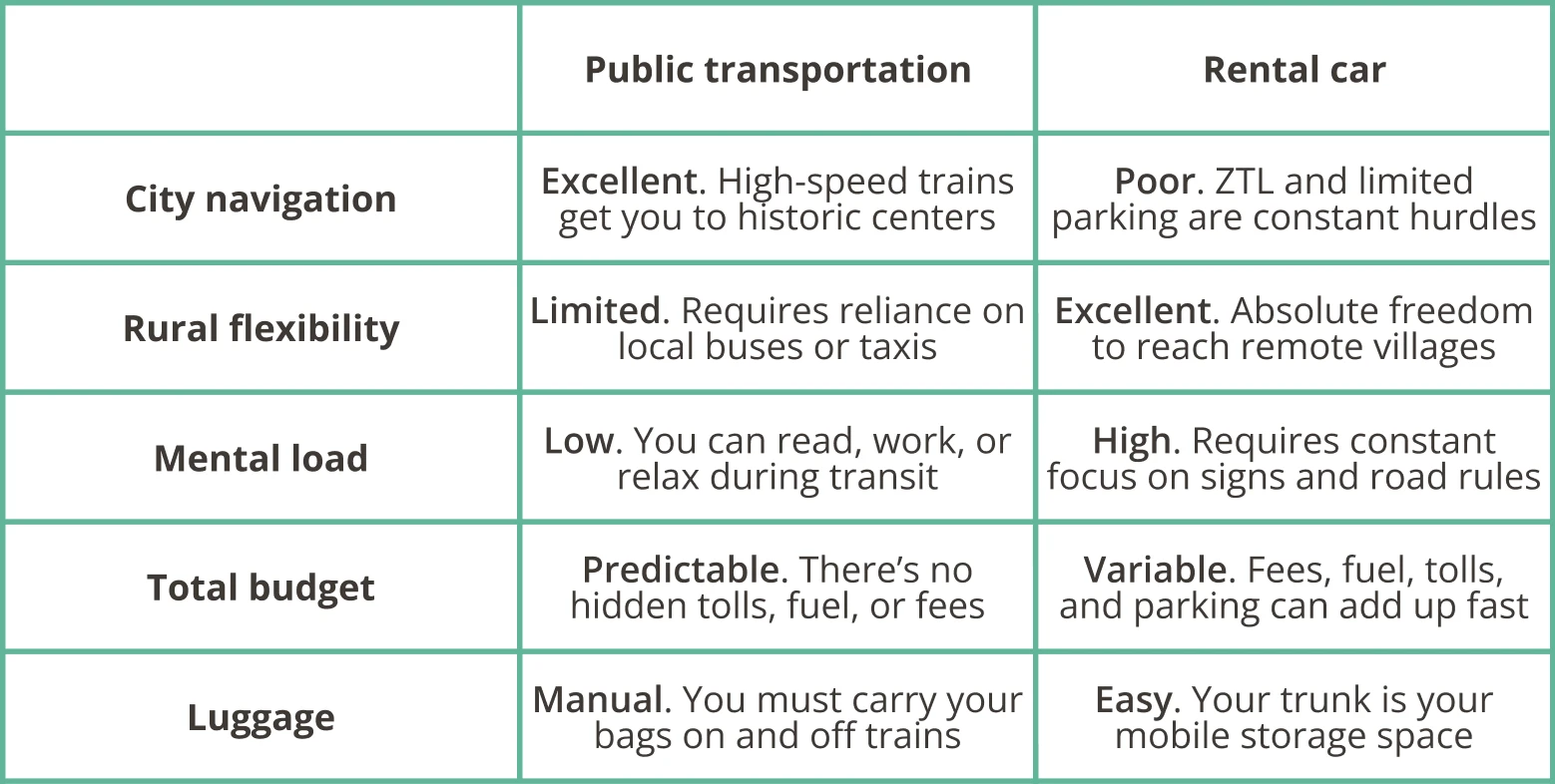
You don’t really have to lock yourself into one single way of traveling for your entire stay. On the contrary, most travelers lean into a hybrid strategy to leverage the efficiency of Italian public transportation while also keeping the freedom of driving exactly where they need to.
To do so, you can divide your trip into chunks: the urban parts and the rural discovery ones.
For the urban portions of the trip, you rely on the high-speed rail network. It’s faster and cheaper, and it helps you bypass the nightmare of urban driving. And when you’re ready to move to the countryside, you can add a car rental. You just need to pick up your rental at a location outside the city center to bypass the urban traffic and the stress of the STL zones entirely. And when you’re done? Try to plan the drop off in an accessible town along a main train line. That way you can hop on a regional train and rejoin the main rail network for your next urban stop!
We help you experience Italy with guidance, support, and programs designed for real life abroad!

.webp)

.webp)
.webp)
What is Italianforawhile?


Enrollment and admissions


