If you’re learning Italian and you already know a little bit of Spanish (or vice-versa), you might have a “secret advantage.” In fact, these two languages are so similar that many people jokingly say they are the very same. And while that’s not really true (they “only” share 82% of their words after all), their overlap is more than useful for anyone learning the language!
Let’s dive right into the heart of the matter: the reason for all the similarities between Italian and Spanish comes down to their heritage. Both, indeed, are Romance languages and descend from the Latin (more specifically, the Vulgar Latin) that the Romans spread across Europe.
Because of this:
Now, as you can imagine this doesn’t mean that you can instantly switch from Spanish to Italian and fully understand everything from day one. But it does mean that you’ll be able to recognize a lot of words and grammatical forms, which is a huge help when starting out!
If you already speak Spanish and are learning Italian, you’ll see many words that make you go “Oh, I know that!” Just to give you a few examples:
These huge similarities are one of the most encouraging parts about studying both languages (either at the same time, or one after the other). After all, you don’t have to start from zero!
Just looking at what we said before, one might think it’s all sunshine and unicorns. However, there’s always a but. And in this case, the “but” is entirely made up of “false friends,” those words that look the same but mean totally different things. And, more often than not, cause big misunderstandings.
Here are some examples!
So, yes, Spanish will give you a big head start in Italian learning, but you’ll still want to pay attention in class and learn all the differences. It will help you avoid some real epic fails!
Because both languages evolved from Latin, they’ve followed similar (though not identical) phonetic shifts over time. If you recognize them, you’ll be able to “decode” new words even without a dictionary.
Let’s give you a few examples!
As you surely know, both Italian and Spanish assign gender (either masculine or feminine) to nouns. That means that everything, from “the” to “beautiful” changes slightly depending on whether the word they refer to is masculine or feminine.
For example:
This means that if you already know how to handle gender in Spanish, you’ll feel right at home even when learning Italian. After all, the logic is the very same!
The conjugation system is another point where the languages show their similarity. Both languages, indeed, have a fairly rich (and complex) system, including different persons, tenses, and moods.
Let’s make a simple example and compare the verb “to eat”:
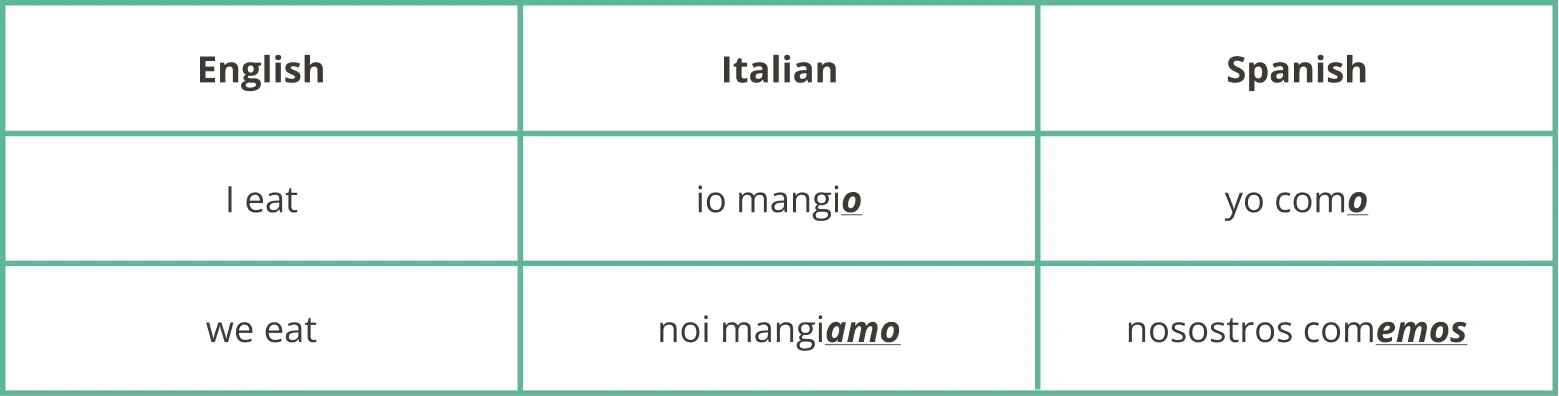
Can you see how similar they are? They both end in “-o” in the first person singular and in “-emos” or “-amo” in the first person plural. And this is only the beginning.
Both Italian and Spanish usually follow the Subject-Verb-Object (SVO) pattern in simple sentences. The only difference here lies in flexibility: Italian, indeed, allows you to reorder the words for emphasis, especially when speaking.
To give you an example, “Io mangio la mela” is the normal, non-stressed way to say “I eat the apple”. However, “Mangio io la mela” is still perfectly correct. It just stresses, by order and pronunciation, that I am the one eating it. And while Spanish can do this too to an extent, it tends to stick closer to the SVO structure.
This means that, if you’re used to Spanish syntax, Italian definitely won’t shock you. But it will give you a little bit of “creative room” to change the sentence flow!
Both Italian and Spanish are phonetic languages. This means that what you see is what you pronounce (at least, almost always) and, once you learn the rules, you can read pretty much anything. However, within this similarity, each language has its own DNA:
When it comes to vowels, for example, Spanish has five clear sounds (a, e, i, o, u) that stay pure. Italian, on the other hand, uses the very same five letters but also introduces open and closed variants of the letters “e” and “o”. For example, “caffè” (coffee) ends with an open “e”, while “perché” (why) uses a closed one. These differences don’t usually change meaning, especially with people from different regions changing pronunciation of the open and closed vowels, but they do affect rhythm and authenticity. Still, if you speak Spanish, you’ll find Italian vowel sounds very familiar.
Talking about consonants, both languages use the same letters. What differs is the way they treat them:
One thing you’ll notice as soon as you start learning Italian is that most words end with a vowel (and those that end in a consonant are generally of foreign origin). This is what gives the language its typical “sing-song” feel, together with the stress that usually falls on the second-to-last syllable unless marked otherwise.
Spanish, on the other hand, has regular stress rules but also allows for more variety when it comes to word ending, also using consonants like “-r”, “-l”, “-d”, “-n”, and “-s”.
Let’s compare the word “love” in both languages:
So remember: even when words share roots and are very similar to each other, us Italians tend to “sing” them, while the Spanish prefer to “cut” them short.
Basically, if you already speak Spanish, you’ve got a huge advantage in learning Italian. But you will have to use it strategically to make the best out of it.
Discover our courses, learn Italian, and experience Italian culture every day!

.webp)

.webp)
.webp)
What is Italianforawhile?


Enrollment and admissions


