We recently caught up with Joshua, who spent over a year abroad in Italy, calling both Turin and Milan home. For Joshua, moving abroad wasn't just about travel—it was about hitting the "pause" button on a life that felt like a never-ending cycle of professional benchmarks.
In our chat, he shares why he needed to step away from his comfort zone, how he found a home in a foreign city, and the lessons he learned about career, community, and the beauty of just breathing for a while. If you’ve ever wondered what it’s actually like to pack up and start over, Joshua’s story is the perfect place to start.
There were different reasons, but mainly it was because I was hitting a rut both at work and in my personal life, and I realized that I needed a change.
I was working in medicine, and the goal was obviously to end up in med school. But at the same time, I was wondering “Is this something I want to do?” If I commit to it, I won’t be able to travel for at least ten more years. Plus, I wanted to get my head in the right space, give myself some time to think, and explore who I am a little bit more. In America, we are such a “go, go, go” society, and I really wanted a break from that. So I took a step back to explore who and what I can become. Because you never know until you’re away from home and you sit with the uncomfortable feeling of, “Okay, I have to face this. What am I going to do?”.
There were two main reasons. First, I was looking for European adventures, and at the time, Italy was something I had experienced before and whose culture, society, and history I loved. And secondly, you made it much easier to choose Italy rather than going somewhere else.
Honestly, I didn’t even know Turin existed until I started looking into it. But after watching videos and researching it, I realized just how cool the city could be. It felt more like the “real” Italian experience and it’s big enough that there’s an airport to fly into (priorities, of course!).
But there was also something else calling me toward it. My father had been to Turin before with my grandfather, and he told me to just do it. It was, in a way, a full-circle moment. He even came to drop me off and said “Oh my God, I went here 30 years ago.” And we were able to see the museums and all the famous spots. It was really nice to see my father walk down memory lane while I stood side by side with him. Especially since I never got to know my grandfather much. I really couldn’t have asked for a better city!
Honestly, at first I didn’t even realize I had the opportunity to change, but I’m glad I didn’t because by month ten Turin really felt like home. By then, I was ingrained in society and felt part of the community. Everything became a routine: “Tuesdays we go here, Wednesdays we go there.” I also got to see all the seasons and, overall, it was nice to call Turin my home base.
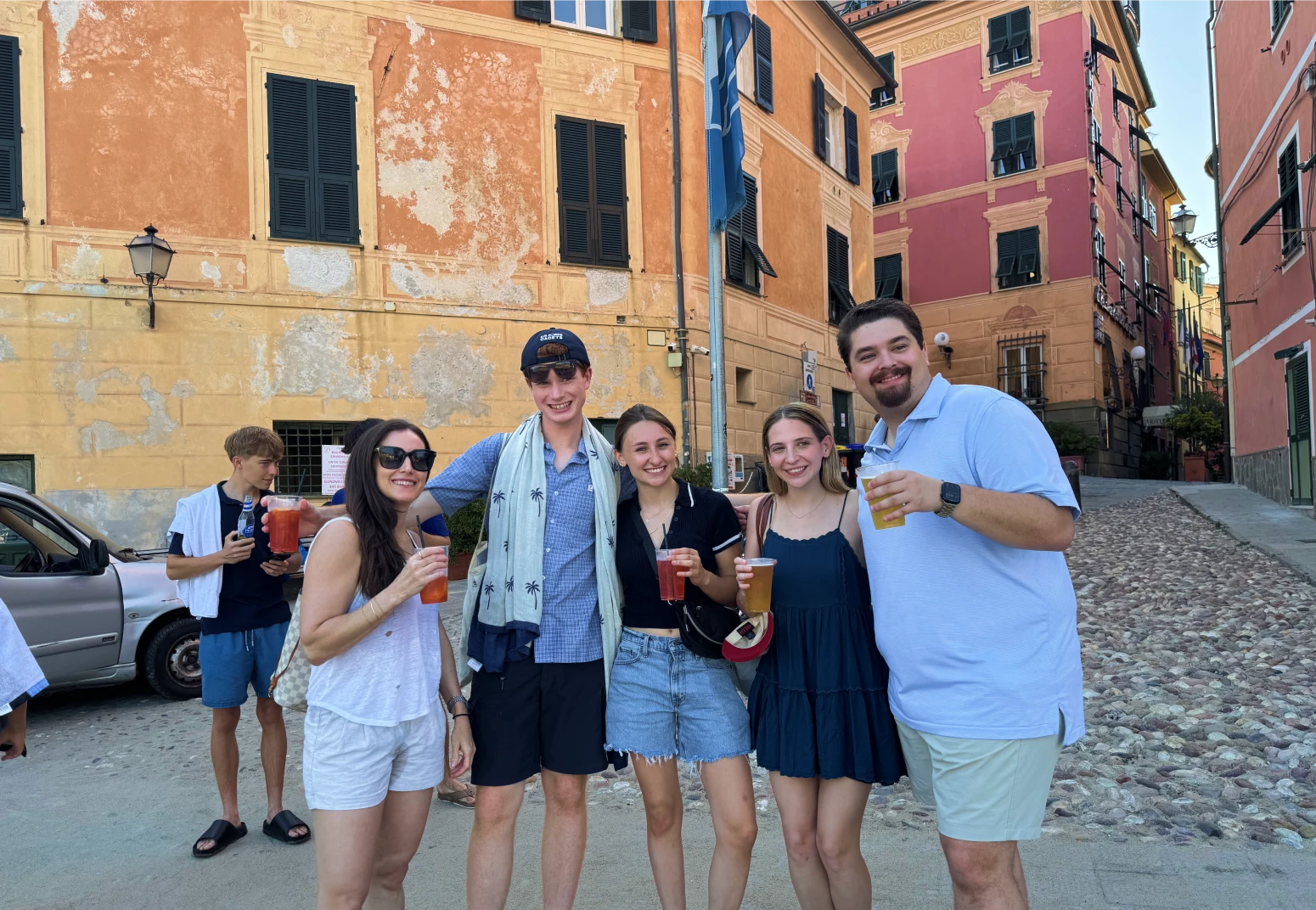
Being in Italy for so long gave me the chance to participate in so many activities and meetups (Sestri Levante, Florence, Milan, Genoa, and Turin). Each trip felt like a catalyst: you’d meet a new group of people, and that would lead to another weekend, which would lead to yet another trip. It was wild how these weekends formed a whole new friendship group! I’ve made friends for life that I would have never met otherwise, and we’ve already started planning visits to each other’s homes back in the States. It’s so much easier to connect with people who are going through the exact same experience as you. And, honestly, I’d do it all over and over again.
It became this natural thing where we’d host each other over. We’d make dinners, hit the clubs, and end up with ten mattresses lined up through the living room and hallway. It was amazing because you get to meet someone else in their own town and live like them for a few days.
When friends came to visit me in Turin, I became a self-appointed, certified tour guide for the Egyptian Museum. I think I’ve seen that place a hundred times now! It’s also a huge part of the growth process; you learn how to be a good guest and a gracious host, all while navigating trains and traveling together. Whether it’s one night or two, it’s manageable, and it builds such a strong sense of community that I’d recommend to anyone!
It’s crazy actually. I’ve seen people change over the course of two weeks, so when oìyou look in the mirror after ten months in Italy, it’s like, “holy crap, I’ve literally become a whole new person”. It’s not in a way where my mom says I’ve changed completely, but more that I’m able to turn certain doubts or struggles into positive things; they’re now abilities instead of struggles.
I feel like I became a better version of myself than I ever would have been if I hadn’t come to Italy!
My best memory is when my father and mother came to Italy for my mother’s birthday. We had many amazing days visiting museums and having aperitivos. It felt like being a kid again, with mom and dad taking me to the park, but it was me taking them to the park instead. It was a weird full-circle moment, being the one ordering for them in Italian and seeing them smile even though they had no idea what was being said half the time.
On the flip side, the hardest moments weren’t the loneliness or anxiety; those were pretty easy to overcome. The fear really settled in closer to month ten, when I realized I had to go back to America and be a person again, wondering if I was going back to being who I was before. The fear of learning was much bigger than the fear of coming to Italy. It felt like being ripped away from my family and community. But even when I went back home, I knew I was coming back soon to work as a volunteer at the Winter Olympics. So my mindset wasn’t “I’m home.” It was more like “I’m on vacation and I’m going back.”
Back home, there’s so much pressure to do things in a certain way. That’s why I love Italy, where expectations aren’t nearly as intense. Instead of the constant “What’s next in your life?” people here are asking you about the next dinner or the next aperitivo. And that opens up so many more options.
In the States, we feel like we’re failing if we’re not doing an internship by 18. It’s a cycle of “You have to go to high school, college, get a master’s, an MBA, a doctorate, 20,000 internships to do well in life” and you grow up feeling like you have to hit all the benchmarks just to reach the next level. But they are not actual requirements. They’re expectations, and the one really setting them is you.
Coming to Italy gave me the space and perspective to finally ask myself “What are my expectations?” and I have new ones for myself now. Pursuing medicine or an MBA are still options of course, but they aren’t the only ones anymore.
My Olympic experience would have never been possible without the first 10 months in Turin.
To get the Olympic accreditations, I had to do training and interviews, and write emails in Italian (skills I have never used before). Without my experience, I would have never had the language skills I needed, and I surely wouldn’t have known the Italian mindset and culture as I do now. That, combined with my past work in America on ambulances and in stadiums, molded together to give me this change. And it was insane! I got to meet Snoop Dogg and famous athletes, and I could talk with Olympic families and fans from 94 countries. It was just amazing!
I would say the first thing you have to look at is internally. If you are having these "what if" questions, then the answer is go. If you are looking for more out of life or wanting more out of you, then without a doubt, take a gap experience. You don't have to be an 18-year-old straight out of high school to come out here. There is always a time to take a break in life!
Our programs will help you create your own unforgettable Italian story!


What is Italianforawhile?


Enrollment and admissions


