If you’re planning to study in another country (at least for a while), you’ll immediately run into two terms that seem to mean the very same thing: exchange programs and study abroad programs. And the worst part? They are usually used interchangeably by everyone. Students, universities, blogs, teachers… And that only adds to the confusion.
In reality though, exchange programs and study abroad programs are built on different models and have different goals and expectations. They can both offer meaningful international experiences, but they work in different ways and suit different types of students. That’s why you should understand the differences between them before you apply!
A study abroad program is any academic program that allows students to follow lessons and complete coursework in a country other than their own for a limited period of time. This can, of course, include summer programs, semester programs, or full academic year options.
More in practice, most study abroads are third-party programs. This means they are run by organizations that partner with universities abroad and coordinate all aspects of the program, from academic offering to housing and credit transfer requirements. Basically, instead of enrolling independently in a foreign university, students can apply through the provider who will manage the whole process.
Study abroad programs can vary widely, but most of them aim to reduce the logistical complexity of enrollment in a foreign institution while still maintaining academic rigor. Here’s a recap of their main features:

An exchange program is a specific type of international program that’s based on a reciprocal agreement between two universities. This means that the home institution has to stipulate a formal partnership with a university abroad. Only then are students exchanged between the two schools for a set period, usually a semester or academic year.
As an exchange student, you actually are enrolled at your home university even while studying at the partner institution overseas. Tuition is paid to the home institution, and the credits you earn abroad are transferred back according to pre-approved agreements. However, such programs are often limited in availability, have fewer customizable elements, and are generally tied to certain departments or majors.
Exchange programs are often better suited to students who are comfortable with a more independent life and with navigating foreign academic and administrative systems on their own. Here’s a recap of their main features:
As we already said, exchange programs and study abroad programs differ mainly in how they are structured. The model itself is different.
Study abroad programs are, indeed, designed around accessibility. The providers know that students come from different universities and that they have different academic requirements. This is why the programs are built to accommodate a guide range of needs. It’s this flexibility that makes study abroad programs easier to plan and enter, particularly for students that can’t access exchange programs.
Exchange programs, on the other hand, are designed around balance. Colleges aim to send and receive the same number of students, mostly within specific faculties and academic areas. This ensures fairness between institutions, but it can also limit flexibility for students.
These differences don’t only influence participation and ease of access. They also directly influence academic options, costs, housing, and support.
Academic structure and course options are one of the most significant factors when comparing exchange programs and study abroad programs:
Cost is often a critical factor when students are choosing to study in another country. But, when it comes to exchange and study abroad programs, tuition alone doesn’t tell the full story:
Depending on your personality, you might want to be more or less supported by the program you choose. Carefully consider the support levels based on your preferences:
Cultural immersion is possible (and encouraged) in both exchange programs and study abroad programs, but it happens differently:
By now, the differences between exchange programs and study abroad programs should feel clearer. However, since many of these differences are structural, it can be helpful to step back and look at them side by side.
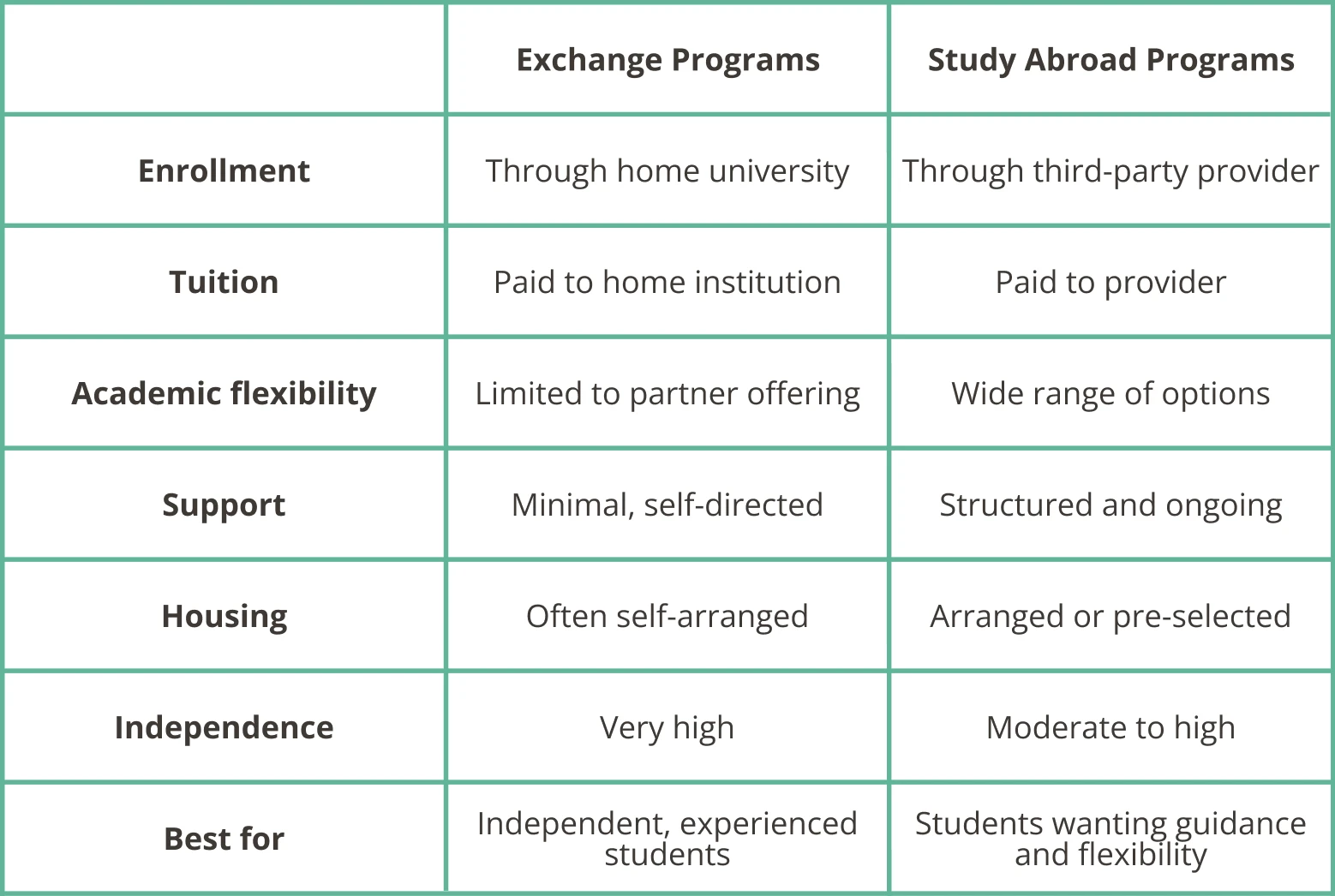
As you can see, the contrast between exchange programs and study abroad programs isn’t really about which option is “better,” but more about how they are designed to work. Exchange programs tend to prioritize institutional balance and academic integration, while study abroads are built to accommodate a wider range of needs and expectations.
As we just said, there’s no universally “better” option when comparing types of programs. The right choice depends entirely on what you’re looking for: your academic goals, your comfort level with independence, your financial considerations, and any prior international experience.
If you have a very clear academic path and are comfortable navigating unfamiliar situations independently, exchange programs will work just fine. However, if you’re looking for more flexibility and predictability, and would love to have more support throughout the experience, then study abroad programs might be the better choice!
Our programs will help you create your own unforgettable Italian story!

.webp)

.webp)
.webp)
What is Italianforawhile?


Enrollment and admissions


