For most working adults, time off usually means one thing: a one- to two-week vacation squeezed between meetings, deadlines, and email notifications that never really stop. However, there’s a growing middle ground between a short holiday and quitting your job to travel the world. It’s called “mini sabbatical.”
Mini sabbaticals are essentially short breaks from work (usually anywhere between two weeks and three months) taken with the intention of stepping away from routine, recharging, or exploring something different for a while. They’re the perfect compromise for people who would like to take a sabbatical but can’t realistically disappear for a year. Long enough to reset your mind, but also short enough to really fit into “normal” life.
If you’ve ever wondered whether taking a break like this is realistic, or even acceptable, you’re not alone. Most people do, mainly because they need reassurance that stepping away from work for a while isn’t irresponsible. And what they find out is that, in reality, mini sabbaticals are becoming more and more common!
A mini sabbatical is a short, planned break from work that’s designed to give you time away from your normal routine. Typically, it lasts somewhere between two weeks and three months, though some people manage to stretch it slightly longer.
You might also hear people call it a mini gap year or adult gap break. The names differ, but the idea behind it is essentially the same: a temporary break from your regular professional life to focus on something else.
In practice, that “something else” can take many forms.
Unlike traditional sabbaticals, which often last six months or even a full year, a mini sabbatical is designed to be more flexible and realistic for people with jobs, responsibilities, and limited time off.
It’s not about disappearing from your career or putting your life on hold. Instead, it’s about creating a meaningful pause: long enough to step away from daily pressures, gain some distance from work, and come back feeling more energized, and often with a fresh perspective on what you want next.

At this point, you might be wondering: how does a mini sabbatical differ from a traditional sabbatical? Aren’t they the same thing?
And yes, the two come from the same idea: taking a break from work to focus on something meaningful outside your usual responsibilities. But while traditional sabbaticals are common in academia to allow professors to focus on research and personal development, mini sabbaticals offer workers from all industries a shorter format that’s much easier to manage.
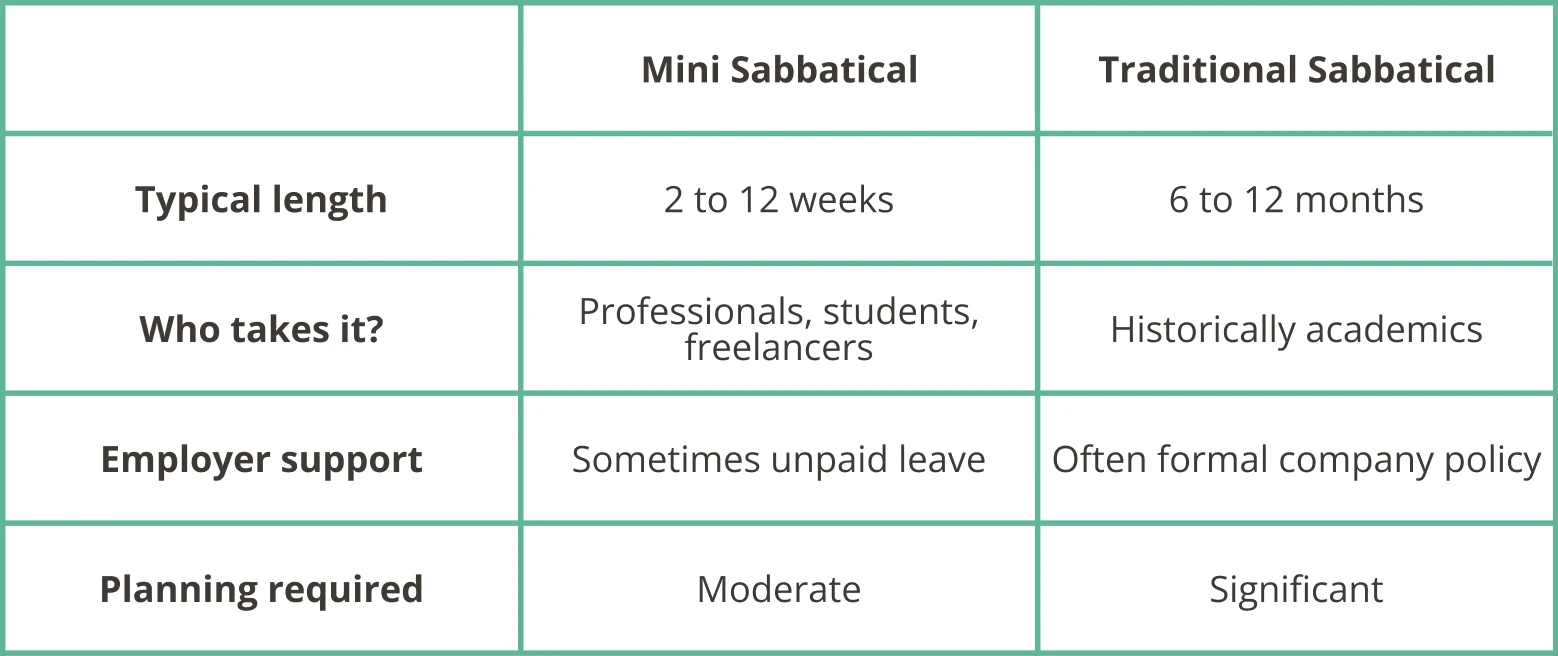
That shorter format is what makes mini sabbaticals appealing to many professionals. They basically offer most of the benefits of a traditional sabbatical (e.g. time to reset, explore new interests, and gain perspective) without needing to leave work for a full year!
A decade ago, taking a few months off work often felt like something unrealistic only a tiny minority of people could actually do. But nowadays, attitudes around work and burnout are changing, and more and more professionals are realizing that short career breaks can actually improve long-term productivity and well-being.
Several factors are driving this change:
In many ways, mini sabbaticals offer some of the benefits people associate with a full gap year, but in a format that feels much easier to fit into normal working life.
For most people, the idea of taking a mini sabbatical doesn’t appear overnight. On the contrary, it usually builds slowly, mostly because you notice small signs that your mind needs more distance from your inbox, notifications, and everyday responsibilities than a normal vacation can provide.
Here are a few signs it might be worth considering.
But remember: none of these signs mean you absolutely must take a break. They simply can be signals that your mind might benefit from stepping away for a while.
Many people just assume that taking a mini sabbatical could harm their career. But interestingly, most people who take one report the opposite experience.
A short career break can, indeed, bring several benefits!
In short, taking some time off work doesn’t harm your professionalism. It can, on the contrary, strengthen your relationship with your work.
Despite the growing popularity of mini sabbaticals and mini gap years, many workers still find it uncomfortable to even consider taking one. The worries are always similar, but most of the time they are just psychological barriers to overcome!
Social expectations are a huge barrier for most workers. They worry that colleagues or friends will see the mini sabbatical as irresponsible or indulgent. But, in reality, attitudes toward career breaks are changing quickly and taking intentional time off is more and more seen as a thoughtful decision rather than a reckless one.
Most people who eventually take a mini sabbatical say the same thing afterward: they spent months (or even years) waiting for some sign that it was acceptable. But the truth is, most breaks are self-created. People negotiate leave and plan transitions between jobs. You simply have to realize that you don’t need universal approval to step away for a while.
Cost is another major concern. Not everyone can afford months without income, and that’s a real constraint, but mini sabbaticals actually turn out to be less expensive than people expect. Since travel styles vary widely, and some people choose simple options like volunteering or staying with friends, planning a low-cost mini sabbatical is more achievable than most people think.
This is perhaps the most common worry, but in most cases, a short career break isn’t a problem at all. On the contrary, most people discover that a mini sabbatical can create clarity about what you want next. Something that’s very difficult to achieve when you’re stuck in daily routines.
Coming back to work after a mini sabbatical can feel surprisingly refreshing. Still, the first days back can feel a little overwhelming: emails probably piled up, you have to quickly restart your routines, and it’s very easy to fall back into the same patterns that made you feel exhausted before the break.
That’s why the way you re-enter your work life matters almost as much as the sabbatical itself.
Here are a few ways to make the transition smoother and make sure the benefits of your mini sabbatical actually last:
Ultimately, the goal of a mini sabbatical is not to escape work forever, but to create enough distance from it so that you can return with better balance and clearer priorities!

Most mini sabbaticals last between two weeks and three months. Some people keep them on the shorter side if they’re limited by work policies, while others prefer to extend them slightly, especially if they’re taking time between jobs.
It depends on the company. Some organizations offer formal sabbatical policies (for longer or shorter periods of time), while others allow employees to take unpaid leave or extended vacation only if arranged very well in advance. In many cases, if sabbaticals are not available, people take one during a career transition.
They can be, but don’t necessarily have to be. A break from work can be more or less expensive depending on the activities you choose to focus on (e.g. international travel, personal projects, learning experiences, etc.).
According to most professionals, a short and intentional break doesn’t negatively affect long-term career prospects. On the contrary, many people return with new skills, clearer goals, and more motivation. All things which can benefit careers.
A mini gap year is essentially another name for a mini sabbatical, usually referring to a short break designed for travel, volunteering, or personal development.
Our programs combine language learning, cultural immersion, and full support!

.webp)

.webp)
.webp)
What is Italianforawhile?


Enrollment and admissions


