Choosing to spend a semester or a full year in Italy is the easy part. Choosing exactly where to live and study is where things get tricky. Italy has many beautiful destinations, each one offering a completely different experience, but even so, for most students the list quickly narrows down to two heavyweights: Florence and Rome.
The two cities are less than two hours apart by train, but choosing between them isn’t just about picking the prettiest future backdrop for videos and photos. The choice defines how early the alarm clock will need to sound, how much energy you will burn just getting to your first morning lecture, how fast your Italian will improve, and whether your semester will feel like a campus bubble or a real “trial-by-fire” immersion!
Your daily life in the city (and how walkable and easy to navigate it is overall) dictates how exhausted you will be by the end of the day. And the experience in Florence and in Rome is definitely different.
Florence is built for pedestrians. The historic center is compact and entirely walkable. And it completely lacks an underground subway system (it would end up unearthing thousands of years of Italian history, stopping work for years!). What you do, instead, is walking. Everywhere. From your apartment to class, from class to lunch, from lunch to the library, from the library to aperitivo with your friends. Everything is so close that you can reach it with a short stroll. The catch? You are sharing that wonderful walkable area with millions of tourists. Congestion in the center is relentless, and navigating the city center during peak tourist periods means dodging tour groups and selfie sticks. You’ll get used to it, but it’s definitely a battle!
Rome, on the other hand, operates on a completely different scale. It's a sprawling monster of a metropolis defined by its neighborhoods, ancient walls, and chaotic traffic circles. Here, commuting means dealing with unpredictable public transports and traffic. You won’t be able to walk everywhere. Instead, you’ll have to learn the erratic bus lines (and their neverending delays) and figure out the subway lines. And maybe learn how to dodge scooters and commuters during rush hour like a real Roman. Everything feels like a real European capital, maybe just a bit more chaotic. You won’t live surrounded only by students and tourists. Real life, with its strikes and the chaotic rhythm of millions of locals commuting, happens around you. And it directly affects your daily schedule.
If one of your goals for studying abroad in Italy is walking away with functional Italian, the city you choose will affect that too.
In Florence, people talk in a way that’s very similar to standard Italian. Also, because the city has been hosting international students and tourists for decades, locals are used to speaking clearly and slowly to language learners. They tend to have infinite patience for hesitant grammar, and will often slow down their speech without you even asking. It really does provide a gentle and supportive entry point, helping you to build your confidence without panicking.
Rome is a different beast entirely. It throws you straight into the deep end without floaties, because Romans tend to speak much much quicker and constantly use Romanesco dialect and local slang. Italian in the city rarely looks like the dialogue exercises in your textbooks, and the initial shock can feel brutal. However, if you manage to survive the initial weeks of constant linguistic panic, your skills will scale up exponentially. There’s nothing like learning Italian chatting with a grumpy Roman bus driver after all!
One of the greatest silent killers of study abroad language learning is the “English bubble,” that constant pull to always stick to English-speaking groups because it’s easier than trying to talk Italian with locals.
In the case of Florence, the city is a high-density international hub. Tourists and international students crowd the city center every month of the year, and because of that shopkeepers and waiters at times switch to English the second they hear a foreign accent. Even if you try your best Italian. It’s not that they want to hinder your learning, they just think it’s easier for you and they still need to do their job as efficiently as they can. If you only stick to the city center (and to your international friends) you’ll never get to practice your Italian. That said, practicing the language is not as difficult as you could imagine. You just need to actively cross the Arno river into areas like San Frediano or target locals spots. Just outside the main tourist area people don’t automatically switch to English, I swear.
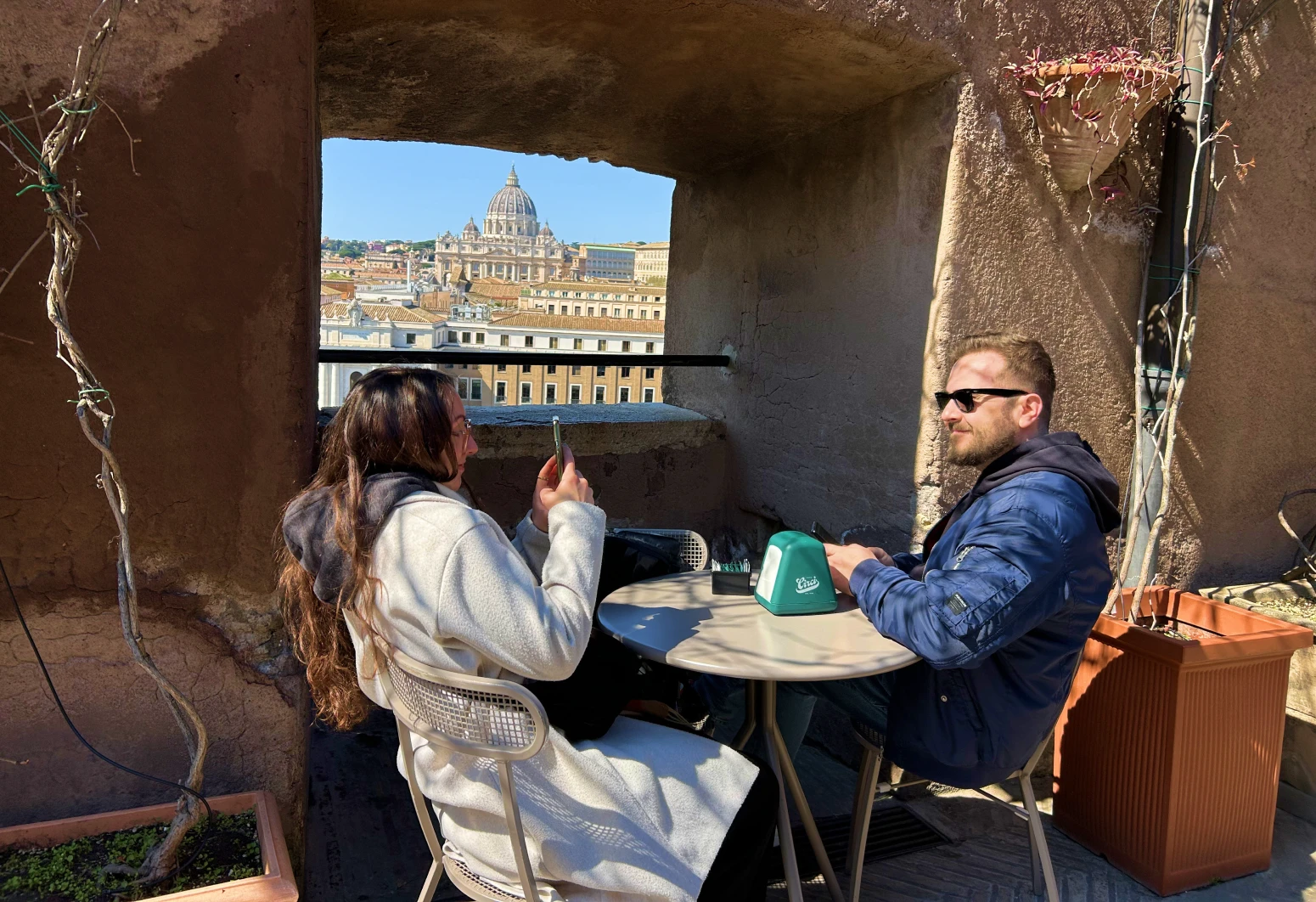
Rome’s massive scale, on the other hand, dilutes its tourist footprint. While the zones immediately around the Colosseum, the Pantheon, the Vatican, and other tourist attractions are indeed saturated with English, the vast majority of residential neighborhoods don’t really care if you’re a tourist or an international student. In these areas, people are not used to catering to English speakers. Some locals and workers might speak English, but they just expect people who get into their shops to talk Italian. Because to them, that’s the norm. And without a constant influx of tourists, they are more ready to listen to you stumble while speaking Italian without rushing you. That’s why, if you want to really speak the language, Rome will naturally force you outside your comfort area. Provided you actually live where the locals themselves live!
Your friends and social circle, and how quick you actually manage to find them, will also depend heavily on the city you choose to live in.
Florence has a sort of college campus vibe. Because the historic center (where classes are held generally) is very small, you will run into classmates and professors constantly. It’s nearly impossible to be just an anonymous face in the crowd. This, of course, can make integration fast: after a few weeks you easily recognize the people you walk into everyday, and finding a friend group is definitely easy when you always keep bumping into the same people both in and outside class. However, the very same situation can sometimes feel like a goldfish bowl. Everyone knows your business and finding a moment of solitude requires real effort.
On the flipside, Rome and its nearly three million people offer absolute anonymity. Right from day one. Being just another face in the crowd can feel isolating at first, but eventually that initial isolation clears the path for a deeper form of integration. That’s because when you finally find your regular local spots (be it a bookstore, a sport club, a neighborhood café, or a study group), the connection feels much more authentic. It feels earned.
Your student budget will definitely stretch and shrink differently depending on your city, neighborhood, and lifestyle choices.
Florence features highly inflated rents in the historic center due to heavy student demand and, as you can imagine, lower rents in the outskirts. However, if you choose to live in the historic center you’re bound to walk everywhere and save money on public transportation. It all depends on what kind of life you’re looking for. It’s also important, though, to consider lifestyle costs. If you live in the city center and get used to daily pastries and aperitivos, costs will tend to creep up rapidly. You’re living in a high-tourism bubble where prices are catered to short-term visitors!
Rome offers a much broader range of housing options across its neighborhoods. Central apartments (around the historical center or near major universities) will clearly be more pricey, but you can and will find much better deals if you live a few tram stops away from the center. The baseline monthly budget however will need to include monthly public transport passes since you will spend more time traveling across the city. But, a good news is that, just by grocery shopping in markets and neighborhood grocers and by eating and meeting friends in non-tourists places, you will save up a lot of money!
Travel is practically a core curriculum requirement for any study abroad program in Italy. That’s why how easily you can escape for a weekend trip matters more than you think.
Florence sits right on Italy’s main high-speed rail line. This means that getting to cities like Bologna, Milan, Venice, Rome and more for a quick weekend getaway is fast and mostly stress-free. You can simply walk into Firenze Santa Maria Novella station, right in Florence city center, about twenty minutes before your departure, board your train (make sure to book it beforehand!), and in a few hours you are in a completely different region, ready to explore. It does remove all travel friction and makes it easy to travel around Italy!
While Rome offers easy train escapes from Roma Termini station (e.g to Florence or Naples), the main advantage to choosing the city as your study abroad destination is the Fiumicino Airport. As one of Europe’s main international airports, Fiumicino gives you endless travel opportunities for long weekends across both Italy and Europe, allowing you to fly directly to countries like Spain, Greece, Egypt, and many more. The trade-off? Getting out of the city to catch your flight! Catching trains to get to the airport adds time, stress, and an extra layer of planning to every single trip.
Neither city is objectively “better.” There’s no universally correct answer for you to make, only the city that suits you better and forces you to grow exactly the way you want.
What city matches the daily life you’re looking for during your semester abroad in Italy?
Our programs combine language learning, cultural immersion, and full support!


What is Italianforawhile?


Enrollment and admissions


