For most students, studying abroad sounds exciting. That is, until the numbers show up.
Tuition fees. Rent. Health insurance. Transportation. Groceries. Suddenly the dream of living and studying overseas starts looking more like a financial risk than an adventure.
But here’s where Italy comes into play.
While in the US it’s completely normal to graduate with years of student debt, in Italy most students manage to get a respected degree without spending a fortune. And the biggest surprise for many students is that the lower cost does not necessarily mean lower quality. On the contrary, Italy is home to some of the oldest and most respected universities in Europe. And public education too is heavily subsidized by the government, changing the entire financial structure compared to the American system.
Of course, tuition is only one piece of the puzzle. You have to factor in living costs, housing, transportation, paperwork, healthcare, and everyday expenses. And the fact that while you can study in English, daily life (from renting an apartment to dealing with university offices and bureaucracy) becomes much easier if you know at least some Italian.
So, is studying in Italy actually cheaper than the US once everything is included? In most cases, yes. But the real answer depends on the kind of university, the city you choose, and the lifestyle you expect!
Tuition is where the difference between Italian university and American college becomes impossible to ignore.
In the US, university costs can easily become overwhelming before students even think about rent or food. Private universities regularly charge tens of thousands of dollars per year, and even public universities can become expensive for out-of-state students.
But Italy works very differently. Public universities are supported by the state, which keeps tuition fees much lower for both Italian and international students. Even at highly ranked public universities. The exact amount, though, usually depends on the university itself, the degree program, and often the student’s family income.
Here is what the difference typically looks like:
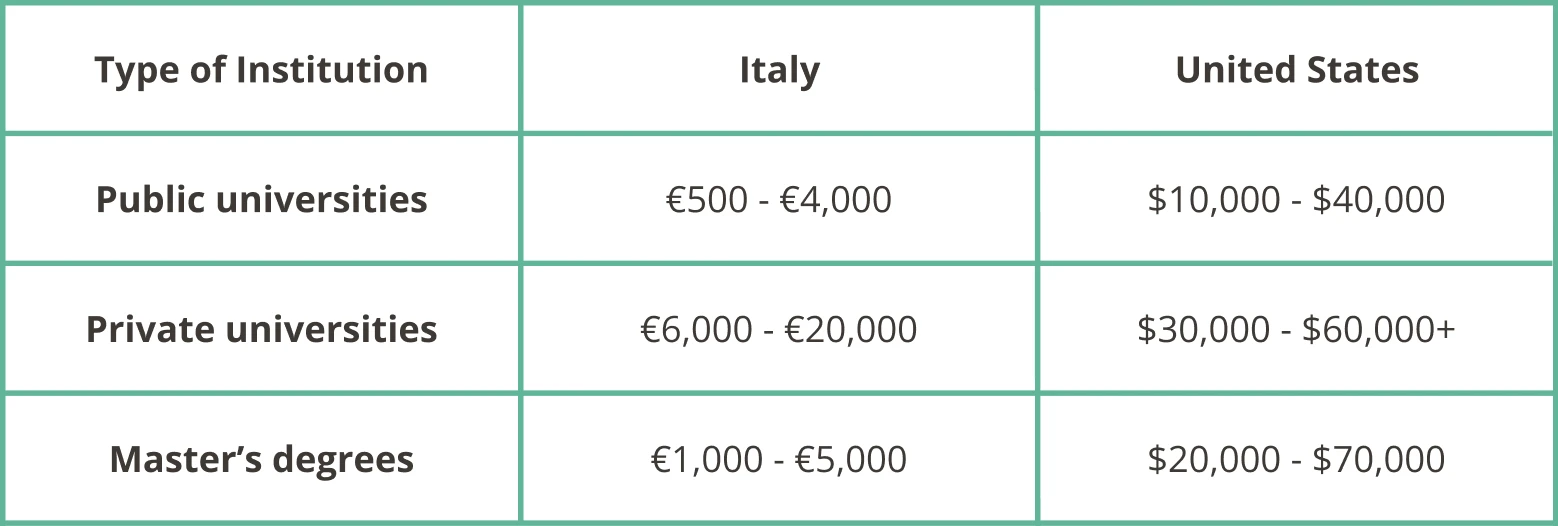
Even some of Italy’s best universities are relatively affordable compared to average American institutions. For example, universities like the University of Bologna, Sapienza University of Rome, or Politecnico di Milano often cost less than many US community colleges once international tuition in America is considered.
And even if private universities in Italy are naturally more expensive, they are still usually far below American private college prices.
If affordability is your priority, public universities make Italy especially attractive. That’s why most international students choose public institutions: they combine strong academic reputations with relatively low tuition fees. And many are centuries old, internationally recognized, and located in cities with large student populations.
What’s more, some of the country’s best-known institutions charge tuition fees that would barely cover a semester’s textbook in the US:
As we mentioned before, Italian public universities operate very differently from the American system. Higher education is treated more as a public service than a private investment, which is why costs are partially covered by the state.
And that is also why tuition often depends on family income.
This part can feel confusing at first, especially for international students, but most Italian public universities use a system called ISEE (or ISEE Parificato for many international students) to evaluate household income and assets. This way they determine how much students should pay for their education. This means that:
Of course there’s a catch: paperwork. Here’s what you’ll typically need:
International students usually need their documents to be officially translated into Italian too. However, this can cause delays and make it easy to miss the deadlines set by the universities, thus ending up paying the maximum tuition.
Yes, and they can make studying in Italy even more affordable. One important thing to understand, though, is that scholarships in Italy work differently from the American system.
In the US, scholarships are often heavily tied to exceptional academic performance, sports, or large financial aid packages connected to student loans. The process can feel extremely competitive, especially at top universities.
Italy, on the other hand, approaches financial support in a more accessible way.
Many scholarships and tuition reductions are based not only on merit (which is still particularly important in certain institutions), but also on household income. The goal here is to keep higher education affordable, and not reserving financial aid only for a small number of top-performing students.
International students can apply for scholarships offered by the university itself, regional governments, or the Italian government. And, depending on the program, financial support may include:
That said, not every student automatically qualifies, and the application process can involve quite a bit of paperwork since authorities often require documents and certificates before their strict application deadlines. That’s why, if you want to rely on scholarships, you should apply early. Just in case.
University tuition is only one side of the equation. Living costs matter just as much. And honestly, this is where the comparison between Italy and the United States becomes more complicated.
Italy is cheaper overall. But not every city feels affordable in the same way.
Milan, for example, can become very expensive very quickly, especially for rent. Rome is not cheap either. While smaller university cities like Pisa, Padua, Turin, or Bologna usually offer a more balanced cost of living.
On average, international students in Italy tend to spend somewhere between €900 and €1,300 per month, depending on lifestyle and location, as you see here below:
Housing is usually the biggest expense, with most students renting a room in a shared apartment rather than living alone to save money. Compared to the US, however, many students still find Italian housing to be more manageable financially. Paying €450 for a room may still feel expensive locally, but compared to rents in New York, Boston, San Francisco, or Los Angeles, it’s often much easier to manage.
Food is another area where Italy tends to work in students’ favor. Groceries are generally affordable and casual meals outside do not destroy your budget. You can still eat well without constantly calculating every single euro!
Transportation too tends to cost less than in American cities. Public transportation is usually student-friendly (with discounts existing specifically for younger people) and many university cities are walkable enough that having a car becomes completely unnecessary. That alone can save you thousands.
Healthcare is not a priority for students planning to study abroad. But, if you’re considering Italy as your destination, it does become a big factor.
In the US, health insurance alone can become a serious monthly expense and medical bills can very quickly turn into financial problems if something unexpected happens. But Italy’s healthcare system is far more affordable for students.
Non-EU students can indeed register with the Italian national health service for a relatively low annual fee, often around €150 to €200 per year. And, compared to typical American healthcare costs, that difference can be huge. Especially if you consider the course of a degree.
It might not be the most glamorous reason to study in Italy, but financially speaking? It does matter.
For most students, it is. And not just slightly cheaper, but often dramatically so.
When you combine tuition, healthcare, transportation, and everyday living expenses, Italy usually costs far less overall than studying in America. But that doesn’t mean every student will automatically save money. Lifestyle choices, city selection, and housing situations still matter. A lot.
But, structurally speaking, the Italian system places far less financial pressure on students than the American one. Here is a simple comparison:
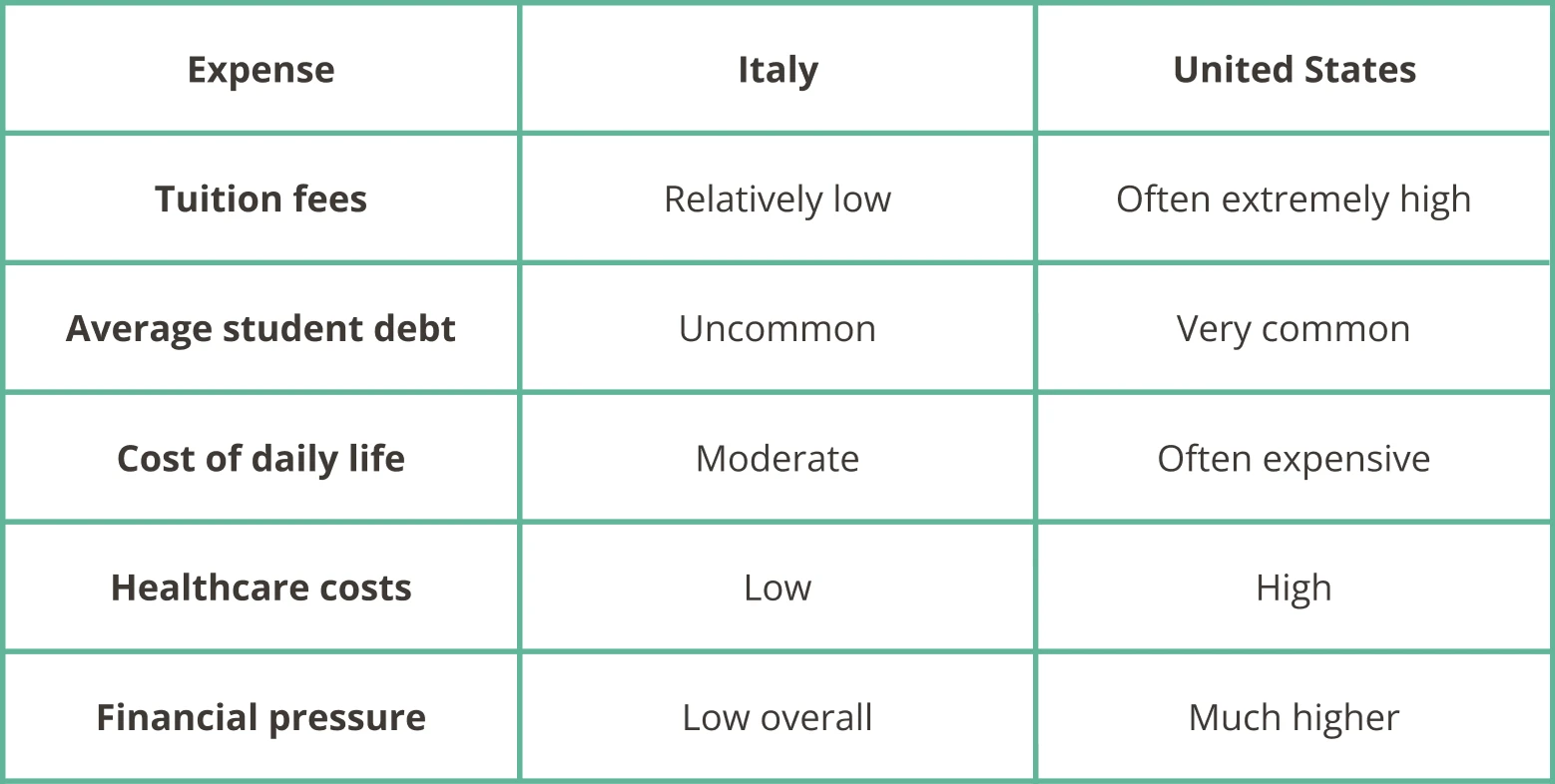
For many international students, these differences change everything. It makes studying in Italy less about “surviving financially” and more about actually experiencing university life, traveling, meeting people, and enjoying the country itself.
In the end, that is probably what makes Italy stand out most: not just the lower costs, but the chance of getting a solid education without building your entire future around debt.
Our programs combine language learning, cultural immersion, and full support!

.webp)

.webp)
.webp)
What is Italianforawhile?


Enrollment and admissions


