Are you looking at universities abroad? Then you’ve probably seen the term “pathway program” pop up. More than once. Sometimes it’s called a foundation program, sometimes a preparatory year, sometimes something entirely different. By this point, one thing becomes clear: different names, same idea.
Pathway programs literally start showing up everywhere once you begin researching international degrees, especially when admission requirements feel confusing or just out of reach. And more often than not, they’re mentioned without much explanation, which ends up creating more confusion than clarity.
They sit in that grey area between “almost eligible” and “not quite there yet,” which is exactly why they raise so many questions in the first place.
At their core, pathway programs are transition programs between one’s current academic background and a desired university degree.
They sit right between high school and a bachelor’s degree, or between a bachelor’s and a master’s degree. And while this “in-between” placement often causes confusion (making people think they’re repeating school or already starting a degree) the purpose of these programs is actually very simple: to prepare students for university in a foreign country. And to do so in a way that matches the expectations of the system they’re moving into.
This preparation is focused entirely on making students able to enter their chosen degree quickly, normally within a year. And to do so, programs combine different elements:
This is the real difference with generic prep courses. Pathway programs are built with progression to a degree in mind. You’re not studying “just because,” you’re doing it to meet the conditions that allow you to move swiftly and without problems to the program you want.
Pathway programs tend to attract students at two main moments of their lives: right after high school and after they obtain a bachelor’s degree. However, within these groups, the reasons they join this type of program vary a lot.
As you can see, the “problems” they face are many and varied. It’s not only about a lack of ability but more like a mismatch between what they are and what the university abroad requires on paper. And that’s exactly what pathway programs exist for: to close that gap without forcing students to start over or take unnecessary risks.
When people think about a pathway program, they just imagine vague preparation or generic classes to prepare for university in general. However, as we already mentioned, these programs combine different elements with one goal: help students enter the specific degree they chose. That’s why the content is usually very targeted and focused.
Of course, a large (if not the largest) part of a pathway program is dedicated to those subjects that are directly linked to the field the students want to get into. And this doesn’t mean jumping into advanced materials. It just means building the foundations that universities assume you already have. Maybe just a bit more, to give students an edge in their first year.
Depending on the specific field, this can include:
The idea is pretty simple. Pathway programs are designed to help foreign students be familiar with the way subjects are taught, tested, and discussed academically already before the degree starts.
More often than not, studying in another country means learning in a different language. At least when students are unable to enroll in English-language courses.That’s why pathway programs tend to teach the language too, from the very basics to academic setting depending on the level of the student enrolling.
The focus here is not being able to casually talk to people on the street. It’s to make students able to talk and learn in an academic setting. And this includes understanding lectures delivered at normal speed, reading dense academic texts, writing structured essays, and sitting written or oral exams without messing up because of the language.
During these classes students work on academic writing, listening comprehension in lecture-style settings, discipline-specific vocabulary, presentation skills and much more. Even students who already “speak” the language benefit from it, because academic language is an entirely different skill set!
Every education system has its own unwritten rules. And students choosing to study in a different country often have difficulties adjusting. They don’t understand how much independent study teachers expect, if participation is graded or not, how exams are structured, how students interact with professors and much more.
To help them, pathway programs try to make these rules explicit so that they, too, can live their college life without difficulties. For this reason, students enrolled in a pathway program learn:
Students often find this part of the program “useless,” but it’s still crucial. Many students, indeed, struggle not because of the subjects themselves, but because they don’t fully understand what teachers expect.
Studying in a different country isn’t just about adapting to a new education system. It also means learning how everyday life works and adjusting to a new culture. That’s why pathways programs usually include some cultural orientation elements to their curricula.
Such lessons focus on practical aspects of daily life in the country, like:
By addressing the cultural differences early on, pathway programs help students settle in more quickly. After all, if everyday life feels manageable, they can approach their studies with more focus!
Most pathway programs last between one semester and a full academic year, with few of them lasting less or more than that.
This length is not arbitrary. Shorter programs, indeed, assume a stronger academic background and a higher starting language level while longer programs are designed for students who need more time to fill the gaps by building subject knowledge, language proficiency, or both.
It’s also worth noting that these programs are structured to match academic calendars as much as possible. This means that they will finish at a point where progression into the degree is natural, without long waiting periods. Just enough to rest a little before diving again into course materials.
Now that you know what a pathway program is, you might be wondering: how is this different from entering university directly?
Both options lead to the very same destination, that’s true, but they also assume very different starting points. That’s because direct entry is generally designed for students who already meet academic and language requirements, while pathway programs exist for those who are not fully aligned yet and need some more support to apply.
The differences are mainly about timing, support, and how preparation for university abroad is handled.
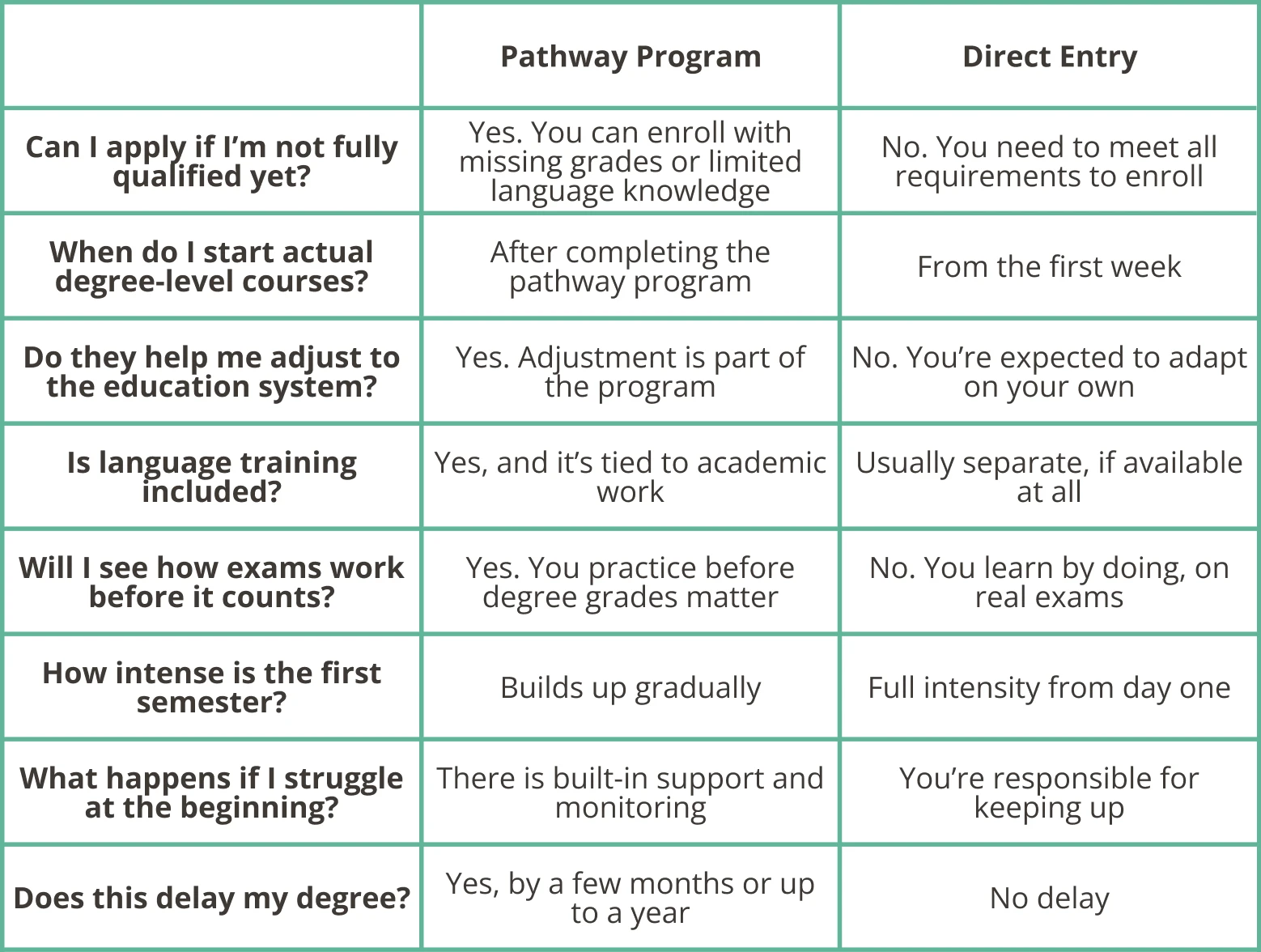
As you can see, neither approach is inherently better. They simply respond to different situations, with some students being ready to step straight into university abroad while others do benefit from a more gradual transition that builds confidence and familiarity first.
What matters is not the format itself, but how well it matches a student’s academic background and language level before applying to the university they want to attend!
Our programs combine language learning, cultural immersion, and full support!

.webp)

.webp)
.webp)
What is Italianforawhile?


Enrollment and admissions


